Angel Zheng
15 min
Published on:
Jul 27, 2025
Burnout doesn’t always look like exhaustion
When I first started my marketing career working for a fintech start up in Vancouver, I had an amazing manager who was always reminding me to slow down. I wanted to hit the ground running since it was my first “big girl job” so every time I finished a task, I was asking for more. I distinctly remember the first time I got a slack message from him saying “all good! No more tasks for today. Feel free to take off, I don’t want you burning out.”
I looked at those last two words with confusion.
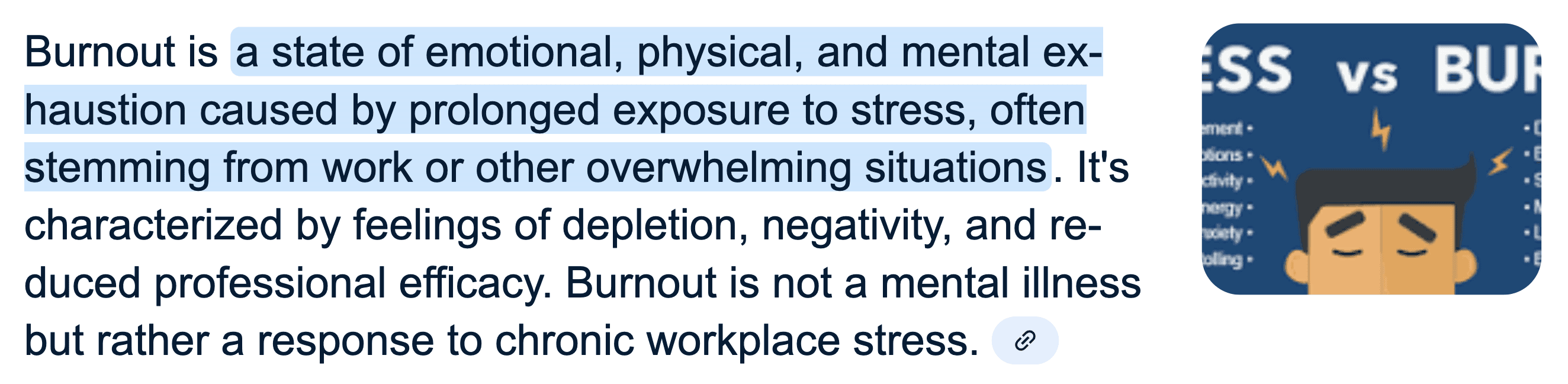
A quick google search told me that burnout is “a state of emotional, physical, and mental exhaustion cased by prolonged or excessive stress.”
But I wasn’t tired nor stressed. I shrugged my shoulders and replied “Sounds good! I’ll check in tomorrow. (:”
I held on to that definition for years, never even considering burnout a possibility for myself. Every time I came across the word, I did a quick check-in: was I exhausted? No. Was I overly stressed? No. I must be fine then!
5 years later, after many therapy sessions and being introduced to the book Burnout: The Secret to Unlocking the Stress Cycle, I realized that burnout had snuck up on me (and that we really needed an updated definition).
Thanks for reading Kinship! Subscribe for free to receive new posts and support our work.
Burnout, redefined
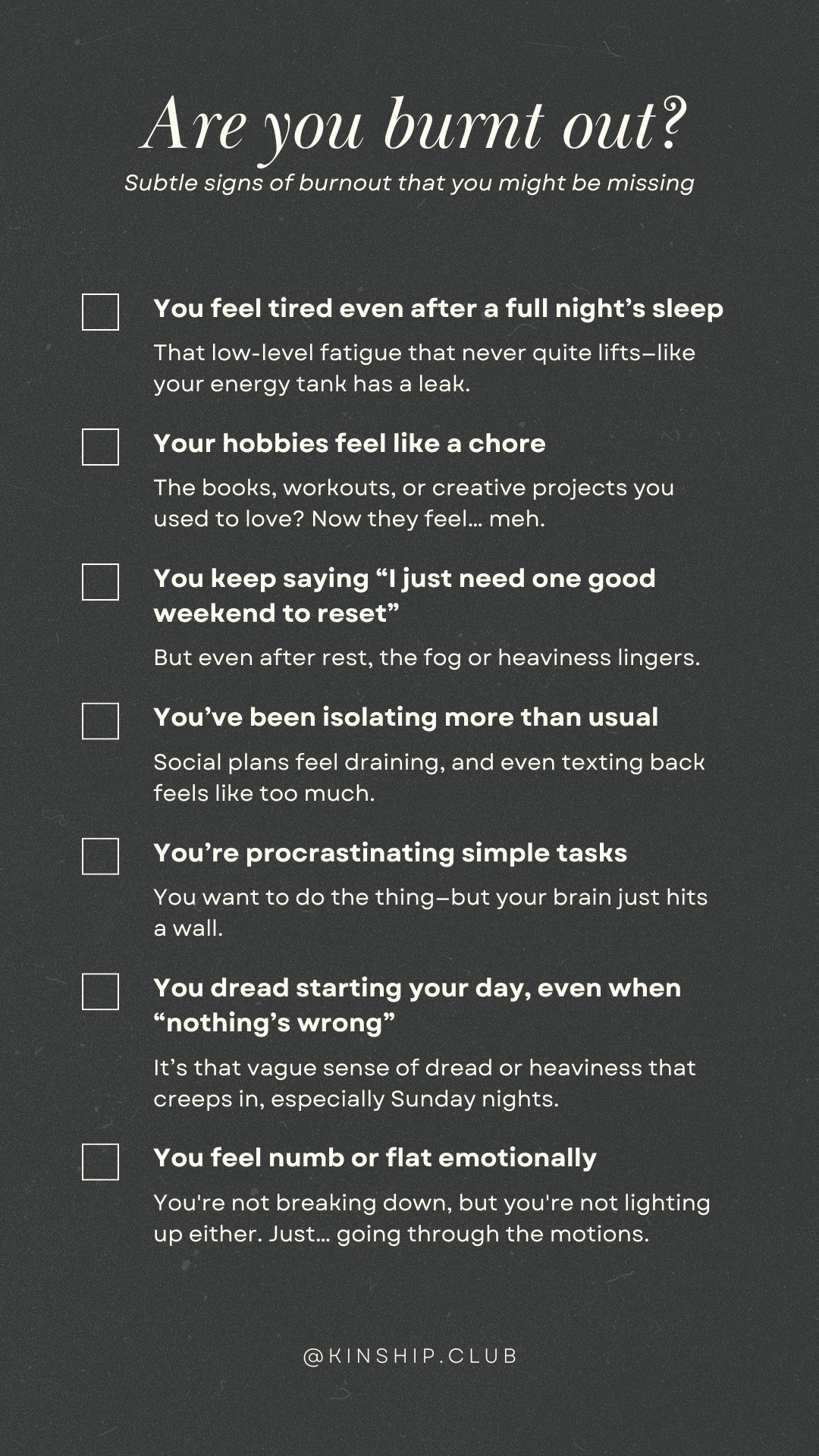
Besides exhaustion and lowered productivity, burnout can also show up through isolation, overall decreased motivation for life, anxiety, cognitive difficulties, emotional strain, and can even affect your sleep and your memory.
I first noticed a decrease in overall motivation. I stopped wanting to do the things I usually loved doing such as reading, working out, and fun activities with friends.
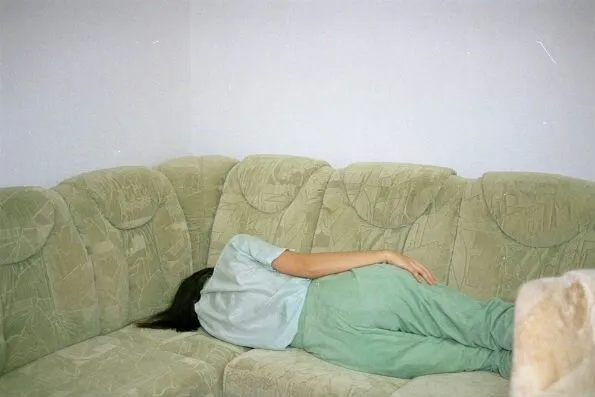
Then came the isolation. I started saying no to more and more social gatherings, telling myself I was just prioritizing alone time and recharging my batteries. Instead, I would just lie on the couch doomscrolling (aka the opposite of recharging).
I also learned that symptoms for burnout and depression overlap quite a bit. In fact, some studies show that 90% of high burnout cases actually meet clinical criteria for depression.
Breaking down the symptoms further, here’s what burnout can really look like.
Emotional detachment: Feeling disconnected from your work, relationships, or activities you once enjoyed
Cynicism: Developing a negative or pessimistic outlook toward work, colleagues, or life in general
Reduced performance: Struggling to maintain your usual standards despite working the same hours
Cognitive dysfunction: Having trouble concentrating, making decisions, or remembering things
Physical symptoms: Experiencing headaches, digestive issues, or changes in appetite that can't be explained by other conditions
Sleep disturbances: Having trouble falling asleep, staying asleep, or feeling rested even after a full night's sleep
Decreased satisfaction: Feeling like nothing you do matters or brings you joy
Procrastination: Putting off tasks you would normally handle promptly, or finding excuses to avoid certain responsibilities
The tricky part is that burnout can manifest while you're still functioning at a high level. You might still be meeting deadlines, showing up to social events (though perhaps leaving early), and maintaining external appearances of success. This is what I call "high-functioning burnout"—where you're simultaneously burning out and achieving, making it especially difficult to recognize or admit there's a problem.
Many of us, especially those socialized as women or in achievement-oriented cultures, have been taught to push through discomfort. We've normalized a state of depletion to the point where we don't recognize it as abnormal. We mistake our ability to function as evidence that we're okay, when in reality, we're operating far below our optimal state of wellbeing.
What helped me recover
Like with most things, awareness is always the first step. Once you’ve admitted to yourself that maybe you’re burning out, it’s time to get familiar with the stress cycle and how to complete it.
I dove into learning about the stress cycle through Nagoski's book. It was eye-opening to discover that dealing with burnout isn't just about removing stressors—it's about completing the physiological stress cycle that our bodies experience. Even when the external pressure is gone, our bodies can still be caught in a stress response.
When our ancestors faced a predator, they'd experience stress, then run or fight, and finally experience the relief of survival. Modern stressors rarely give us that full cycle.
Here’s how I’ve incorporated “completing the stress cycle” into my daily routine:
Physical movement: Even just 20 minutes of walking or dancing can signal to your body that you've "escaped the lion"
Deep breathing: Slow, intentional breathing for 1-3 minutes helps regulate your nervous system
Positive social interaction: A genuine laugh with a friend or a meaningful conversation helps signal safety
Creative expression: Journaling, art, or music can provide emotional release
Physical affection: A 20-second hug from someone you trust can release oxytocin and reduce stress hormones
What surprised me most was that these activities needed to be intentional and regular—not just when I felt overwhelmed. By completing the stress cycle daily, I prevented the cumulative effects of chronic stress that had led to my burnout.
Maybe it's time to redefine productivity
For so long I’ve equated “doing more” with “being productive”. But even as I build this new passion project, Kinship Club, I’m realizing that being intentional with what I do goes way further than just always trying to do it all. I definitely don’t have all the answers yet as I find myself working well into the evening some days. However, I am starting to see that “slower ambition” or “softer productivity” might be the answer to creating something that is sustainable for both me and my community.
Reconnecting
When I think about the mission behind Kinship Club—helping ambitious humans and multi-hyphenates connect, grow, learn, breathe, and unwind—this topic definitely hits home. What I’ve learned is burnout doesn’t always show up as collapse. It creeps up slow and starts as warning signs rather than symptoms. That’s why having spaces like Kinship Club matters.
I want our community to serve as a reminder that we don’t have to navigate ambition, stress, or recovery alone. We deserve communities where we can talk openly about how we feel, not just what we’ve achieved.
Whether it’s through wellness gatherings to tune back into our bodies, dance parties to release all the pent up energy, or just an intimate dinner party to gather and connect—we’re here to make things feel easier.
If any part of this resonated with you, I’d love to know. What has burnout looked like for you? And what’s helped you move through it?
Categories
Recent Blogs
Follow us:


